Clean Break's Artistic Director attends a study day with European prison theatre companies
“If you can dream, you can change reality” Stefano Té, Teatro dei Venti
In the week before the Christmas break, I was invited to participate in a study day in Modena, Italy. The invite was from an award-winning theatre company, Teatro dei Venti The company is led by Artistic Director, Stefano Tè, who has been creating incredible theatre in prisons in and around Modena for over twenty years. I was delighted when the email invite arrived in my inbox, as I rarely get the opportunity to travel outside UK with work, and am unfamiliar with the practice and conditions of those working in prison theatre in mainland-European countries. I felt intrigued to learn and privileged to represent Clean Break at this event.
The study day was entitled DEI DELITTI E DELLE SCENE (Of Crimes and Scenes) and was an opportunity to discuss the prospects and best practices of theatre in prison. It was organised by the Coordination of the Prison Theatre Emilia Romagna, which brings together theatre companies working in prisons in the region with relevant Italian prison authorities. The coalition advocates for the importance of theatre in prisons, providing opportunities to network and increasing access to funding for the work taking place with adults and young people who are incarcerated. The closest thing we have to this in the UK is the National Criminal Justice Arts Alliance, although Emilia Romagna is regionally based.
Teatro dei Venti was co-organising the day, and had arranged for an international panel of practitioners from Berlin (Holger Syrbe, aufBruch), Athens (Stathis Grapsas, Kini Afetiria/Common Starting Point) and London (Clean Break). The day opened with a range of arts and justice representatives from local/regional government speaking about the challenges facing the prison system and benefits of theatre in prison settings, followed by a number of panels including our international one, hearing different ways of working as well as hearing from someone who had participated in theatre projects in prison. We ended the day by moving to Teatro dei Venti’s own base to see an ‘open rehearsal’ of Macbeth with actors and actresses from the Modena Prison and the Castelfranco Emilia Prison.
Here are some of my reflections from the day, on the similarities and differences of our contexts and practices.
It was clear when listening to the different speakers in the morning, that similarly to the UK, this work is led by individuals with huge passion and resilience and a deep commitment to social justice and the transformative power of theatre. It was inspiring and uplifting to hear so much value given to the potential of the work, and to hear this from officials alongside artists.
It was also refreshing that the work was being validated for its artistic quality and ability to express the human condition. There seemed more appreciation of this intrinsic value of the arts for everyone from those in attendance – in the UK we have become experts at speaking about our work in terms of reducing reoffending, improving health and wellbeing, reducing social isolation etc. All important and necessary aspects of what we do, but I was struck by the absence of these indicators in this conversation. There was little justification, and it felt that the artists were held in high esteem for their artistry alone. Listening to Holger Syrbe from aufBruch, Berlin it was inspiring to hear of the artistic ambition of their work. For two decades they have been creating large scale ensemble shows in men’s prisons with high production values that sell out to public audiences within hours of the plays going on sale.
The challenges we have in UK prisons with overcrowding and staff shortages were similar to what was being described on the day. Overcrowding was referenced across the morning as was the need for training and staff to be better equipped to work with those in their care. What I didn’t hear was any discussion about how to reduce the prison population. I was unsure if this was because it was outside of the scope of the study day, or if it isn’t a current strategy. Either way, its absence was noticeable and disheartening for me. I had read about overcrowding and the number of suicides in Modena Prison before I arrived, and understood there was a national crisis of self-inflicted deaths in prisons, so expected to come away with some understanding of how they were proposing improving safety and reducing numbers, but this wasn’t forthcoming.
Acknowledging the known pressures on staff in our prisons, it still feels important to highlight how each of the artists present, despite working in different contexts, described how their work is made possible because of those individual prison staff who champion it. The ones who go the extra mile to make sure the participants get unlocked on time, or who sort out double booked spaces, who notice the benefits and lets you know that they don’t think this work is a waste of time.
It was striking to me how despite the different contexts, all of us are so dependent on these individuals to achieve our work – and more striking that without them, the barriers of making theatre inside prison walls can feel a relentless challenge.
The frequent conversation I have with peers in the UK about our need for the whole institution to enable the work we do, so it isn’t about finding the right person to help things run smoothly, were echoed in Italy on this day.
One of the most remarkable differences between the Italian theatre’s practice and the international companies was made evident during the afternoons ‘open rehearsal’ of Macbeth. A cast of approximately 15 men and five women, with a mix of actors from the local prisons and professional actors, performed the extract at the theatre home of Teatro dei Venti. (Women in Italian prisons make up 4.4% of the total prison population, with the vast majority of women being held in special units in mixed prisons. Women in Prison: Analysis from the National Preventive Mechanism | Italy, August 2024)
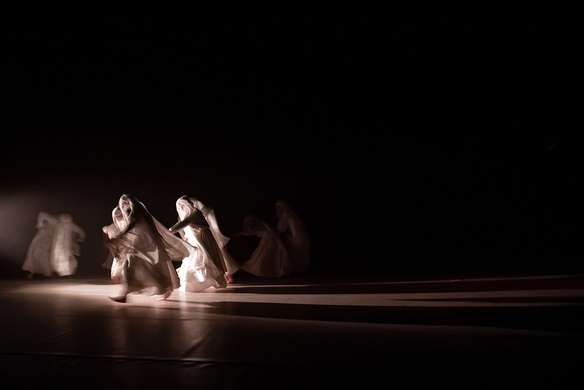
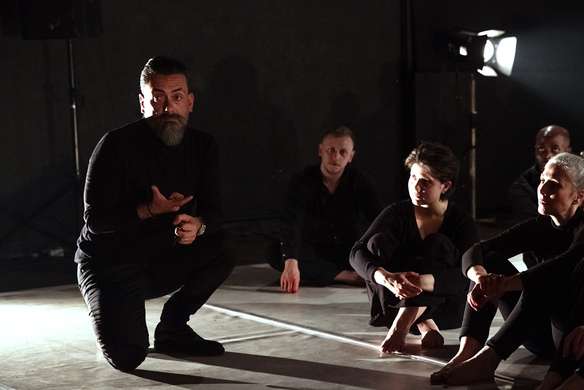
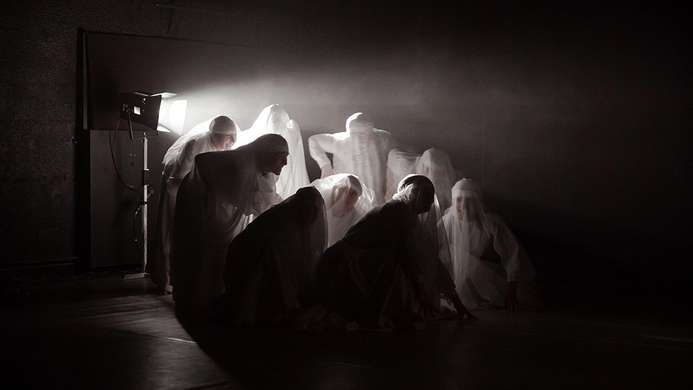
The ‘open rehearsal’ was in fact a fully formed beautiful extract of an adaptation of Macbeth that the group is making with director Stefano Tè, including costume, lighting and sound/music. They rehearse at the theatre intensively for one week every month over the course of a year, so the final production is not due to be performed until November 2026. Following the performance the men and women movingly shared with us their experiences of the process and answered questions from the audience. Once the afternoon concluded for us, the cast then had an hour-long notes session with the director(!) At this point the theatre company staff (with special permits) drove company members back to the prison for the night. The following day they would be picked up in the morning and rehearse once again.
It was fantastic to witness their process and know that they could rehearse at the theatre with their prison cast. All of the international delegates commented on this freedom of movement. The prisons were open prisons (where security is less restricted), however, even in open prisons this is not known practice in our countries. How much easier it must be to nurture a new identity as an artist and leave behind that of a prisoner when you are welcomed as an equal in a professional theatre space?
Later that evening we heard stories of Teatro dei Venti travelling to different regions in Italy with the prison theatre company, with no accompanying prison staff, performing and sharing their work with others. I will preserve that memory and use it to push boundaries of what is achievable in my own context.
I owe a huge dept of thanks to Stefano and all the team at Teatro dei Venti for the invitation, and to Holger and Stathis from Germany and Greece for being such valued companions. I particularly would like to thank Sara Barbieri from Teatro dei Venti for her generosity and kindness, escorting us everywhere, translating, taking us out to dinner and making us incredibly welcome.
I left Modena feeling uplifted and energised by the people I met, what I saw and the conversations we had. It was a valuable reminder of the amount there is to gain from international exchange. There is so much to learn from stepping outside of our own worlds and seeing what is possible in different contexts, building connections across national boundaries and reminding ourselves of what we have in common. In this case a deep passion and a belief in the rights of everyone, even in the bleakest of circumstances, to express our humanity through art.
Photo credit: Chiara Ferrin